Wednesday, June 19, 2013

Micah Crandall-Bear: "New Horizons," a one-man show

Micah Crandall-Bear's upcoming one-person show was featured in the July 2013 issue of American Art Collector magazine. Read the editorial below: 


Sedge  -  acrylic and modified oil on canvas  -  12 X 30

Micah Crandall-Bear’s upcoming solo exhibition at Elliott Fouts Gallery in Sacramento, California, features new abstract landscapes that are reminiscent of his native California lands. Having devoted more than a year to working on paintings for the exhibit, Crandall-Bear says, “I’ve never spent this much time preparing for a show and it really shows. I couldn’t be happier.”
In this, the first solo exhibit Crandall-Bear will have at the gallery, the artist continues a series he calls Develop. The term has several meanings but, in general, it touches upon “the retro, vintage Polaroid,” a theme that runs throughout the paintings and works feature a border similar to the iconic one found on a Polaroid.

Aside from the photography reference, Develop means the development of Crandall-
Bear’s painting process and, as he explains, “the development in abstract landscapes that find a connection to the development of natural beauty and the balance of organic elements.” He adds, “Not necessarily the developments of anything man-made. These are kind of meant to be abstract landscapes that inspire deeper breaths, a greater connection to a sense of peace. My hope is to transfer that sense of natural beauty with a composed balance of elements.”

Stylistically, collectors and patrons who know the artist’s work will notice more of a pop feel. “I am going a lot brighter with the colors and tones in the skies,” says Crandall- Bear, who has been using deep reds and some oranges in the latest pieces. “Some of the older ones are distressed and kind of saturated in the tones, a little more earthy and underdeveloped, if you will, while these ones have a little bit more of a pop to them.”

Paintings such as Sfumato and Ultra are two that are on the opposite ends of the spectrum of works that will be in the show. According to the artist, Sfumato has a bit of an Old Masters feeling landscape, while the sky is contemporary; and Ultra has a vibrant pink and could be thought of as a landscape or a color-field with the horizontal bands of color. “I am a huge fan of Rothko; I use a lot of color-field techniques in my work,” elaborates the artist. “The actual bands of color as opposed to the color-field give it a modern feel.”


The show will hang July 6 to August 1 and will feature approximately 20 paintings.

New Horizons
July 6 - August 1, 2013

Elliott Fouts Gallery
1831 P Street
Sacramento, CA 95811

Friday, May 31, 2013

Christopher Stott: New Paintings, 2013

This month we're featuring the work of Canadian still life artist, Christopher Stott. We're displaying twenty new original paintings, some of which can be found below:

Globe, Black  -  Oil on canvas  -  24 X 24


Going Places  -  Oil on canvas  -  20 X 40


Gumball Quintette  -  Oil on canvas  -  24 X 36


Wide Open Windows  -  Oil on canvas  -  24 X 24


Tell Me A True Story  -  Oil on canvas  -  20 X 20


The Story Teller II  -  Oil on canvas  -  24 X 48


Show Catalog  -  "Christopher Stott: New Paintings, 2013"  -  $20 each

Given that approximately 1,200 miles separate Saskatoon, Saskatchewan, the home of Christopher Stott, and Sacramento, California, distance plays a huge role in the logistics of our relationship.  The delivery of Chris’ work doesn’t include a trip across town; it involves careful packing, coordination, and feelings of anxiety as his paintings make their way, one by one, south, across the Canadian border. This gradual development - piece by piece – is unique in that a one-person show is typically delivered to the gallery in its entirety. This unintended benefit of the process affords us an opportunity to connect with the pieces on an individual basis, much like the artist does in the process of creation.  

In addition, the progress photos that Chris sends to the gallery not only reinforce our connection to the artist but also grant us the opportunity to glimpse into his studio.  These images, purposefully black and white as to not give too much away, feature paintings in their various stages of completion, surrounded by carefully organized tools and a meticulously arranged palette.  A collection of vintage books, typewriters, clocks, fans, and other commonplace objects fill the surrounding shelves, bringing back fond memories of earlier paintings while amplifying the anticipation of future masterpieces. Chris’ clean working environment seems to mirror the exactitude with which he paints, revealing an authenticity that might not otherwise be recognized by merely looking at his paintings.

This sense of authenticity also applies to the fact that Chris’ subjects are not imagined or copied from images; they are depicted from everyday objects. While some books, such as the “Manual Of Psychology” have made multiple appearances dating back to 2009, others like “The Story Teller” and “The Perfect Woman” have recently found their way into his compositions. In this way, it seems that Chris’ commonplace subjects are transformed into characters as soon as they make the visual transformation from three-dimensional to two. Much like in a movie or play, these characters might occupy lead roles in one piece and act as the supporting cast in others. Their physical and emotive qualities are dependent on compositional placement, evoking underlying themes both subtle and obvious.

Chris infuses his paintings with a sense of humanity in which we can identify through our personal experience. In his recent painting, Going Places, Chris features a new book with a title that brings to mind adventure, growth, and progress. These themes are mimicked by the painting’s composition as the novel leans in an upward trajectory, bringing to mind ideas of optimism and future possibility. The piece, Going Places II utilizes the same novel, but with a different approach as it takes on a supporting role both literally and figuratively. The inclusion of the antique clock evokes ideas of time and an ability to capture the moment. Finally, in his painting, Gumball Quintette, the iconic gumball machines gather together as if posing for a family portrait. Though they are of varying colors, shapes, and sizes, they stand connected. 

Six years have passed since the first Christopher Stott painting made its way from Canada to the walls of our gallery. Since then, hundreds of paintings have filtered through, traveling on to collectors worldwide. Despite the distance, we continue to grow together, and it is no doubt that Chris’ passion, creativity, and artistic talent will continue to propel the success of his career into the future. 

Michelle Satterlee
May 2013


Wednesday, May 8, 2013

Gregory Kondos at EFG

We recently acquired an original Gregory Kondos painting that is is from 1973 and in mint condition. The painting features the iconic Sacramento River and measures 5 X 8. 

Gregory Kondos  -  Untitled Riverscape, 1973  -  Oil on panel  -  SOLD


Other available Gregory Kondos originals include:

Gregory Kondos  -  Half Dome Meadow, Yosemite, CA, 2007  -  Oil on canvas  -   22 X 28  - Available


Gregory Kondos  -  Sedona, Arizona, 1986   -  Watercolor  -  10.75 X 8.25  -  Available


To see more of his originals, go to: http://tinyurl.com/chz86jf


Available limited edition lithographs + giclees:

Emerald Bay  -  Giclee on paper  -  20 X 25.5  -  Available


River's Edge III  -  Giclee on paper  -  12 X 34.25  -  Available


River Palms  -  Lithograph  -  23 X 19.5  -  Available


River Cruise  -  Giclee on paper  -  18 X 25  -  Available

Friday, April 19, 2013

Sacramento Bee Review of "A Journey Through Time"


Victoria Dalkey: Roland Petersen retrospective at Elliott Fouts Gallery

Published: Friday, Apr. 19, 2013 - 12:00 am | Page 23TICKET
Geometric abstraction and narrative figuration vie in Roland Petersen's masterful paintings at the Elliott Fouts Gallery. A mini-retrospective, the show moves from nonobjective abstractions from the 1950s to fresh-off-the-easel works from his renowned Picnic Series.

The early works grapple with abstract expressionism, reflecting at times his studies with Hans Hoffman. There is a European sensibility to the works that persists into his output today. Part of this may come from his Danish heritage. He was born in Endelave, Denmark, in 1926. While he received his Master of Arts degree from the University of California, Berkeley, in 1950, he studied during several subsequent periods with the printmaker Stanley William Hayter in Paris.
While his works are informed by the Bay Area Figurative work of Elmer Bischoff, David Park and Richard Diebenkorn, Petersen, who was part of the legendary core art faculty at UC Davis,brings a more rigidly structured approach to his paintings of figures at picnic tables. The results are paintings of great abstract dynamism that also convey a sense of alienation and anomie.
His enigmatic figures stare out at the landscape, assiduously avoiding interaction. While the colors are intensely bright, there is a still chilliness to the scenes, as if they were frozen in time and emotionally impenetrable. The figures, rather than being real people, stand in as compositional elements in an elaborately structured abstraction. Still, these paintings dazzle the eye with lively geometric patterning – stripes and checkerboards – and strong primary colors.
 The most recent painting "Picnic With Checkered Table," done this year, pulls you into its world with a sense of inevitability. Here seven figures inhabit a landscape of flattened space and linear patterns. The red-and-white checkered cloth and the looming blue shadow of the male figure sitting with his back turned to the viewer send mixed signals. It's an idyllic sunny day of lollipop trees and jaunty colors with a dark side, a somber overcast.
"Picnic Day" from 2011 is equally intriguing. Here again we have red and white, this time striped, echoed even in the peppermint field in the distance. But the painting is slashed with dark diagonals, and the faces of the people are all in shadow. In "Picnic With Three Umbrellas," 2012, the shadows from the umbrellas fall in dark circles in a composition that is divided by an umbrella pole that interrupts any flow to the imagery.
At times Petersen departs from the picnic theme, giving us a pair of jazzy dancers, all angles and elbows against an acid-green background. In "Girl Arranging Hair," 2009, he presents a geometric figure, with slashing diagonals and angles in screaming tones of green, yellow and red.

Gentler in feeling is "Interior Figure With Sunlighted Still Life," 1997, done in gouache on paper. Here he tackles a composition that mixes the figure, the still life and the landscape seen out a window. Rendered in rich, atmospheric tones, it has something of the feeling of a Diebenkorn.
He offers two self- portraits, "The Artist," 1959, a tender semi-abstract image that makes one think of the delicate, suggestive color of early works by Hassell Smith, and "Self-Portrait With Reflections," a triple self-portrait with the artist at work reflected in a pair of mirrors. Both are compelling works on paper that exhibit a subtler color range than his typical acrylic canvasses.

It's great to have this show up at the same time as Gregory Kondos' retrospective at the Cocker Art Museum. Both are strong artists who have gone from their beginnings in the Sacramento-Davis area to national renown.
Petersen's works are included in the collections of the Whitney Museum of American Art in New York, the Museum of Modern Art in New York and the Hirschhorn in Washington, D.C.


ROLAND PETERSEN

What:"A Journey Through Time"
Where: Elliott Fouts Gallery, 1831 P St., Sacramento
When: 11 a.m.-6 p.m. Tuesday- Friday, 11 a.m.-4 p.m. Saturday- Sunday, through May 2.
Cost: Free
Information: (916) 736-1429

Read more here: http://www.sacbee.com/2013/04/19/5350252/roland-petersen-retrospective.html#storylink=cpy


Read more here: http://www.sacbee.com/2013/04/19/5350252/roland-petersen-retrospective.html#storylink=cpy

Saturday, March 23, 2013

American Art Collector - April 2013


Roland Petersen: A Journey Through Time

Roland Petersen "Interior Figure With Still Life"  1997  |  Gouache On Paper  |  22 X 29.25

With an art career spanning more than five decades, Roland Petersen has honed his craft into a distinctive style that melds vivid colors, abstract patterns and an extensive understanding of light and shadow. Twenty paintings from throughout Petersen’s career will be on display at Elliott Fouts Gallery in a solo exhibition, April 6 to May 2.

Petersen began his career as an abstract artist. After receiving his master’s degree in 1950 from the University of California at Berkeley, he studied with Hans Hofmann for a year. Petersen then dabbled in printmaking in Paris and was an art history teacher in Pullman, Washington. His studies and jobs led him on a path from abstraction to realism. In 1956 he was hired as a professor at the University of California, Davis, where he taught for more than 35 years. During this time he was introduced to the region’s figurative artists who worked with big, blocky forms. This infused a more expressionistic style into Petersen’s paintings, leading to the work he has created since the 1960s.

Roland Petersen  "Picnic Day" 2011  |  Acrylic on canvas  |  24 X 48

Picnics have been a common subject in Petersen’s artwork. Born in Denmark, his family moved to San Francisco when he was a child. “My parents were members of a Danish club...and annually they would have Danish picnic parties,” recalls the artist. “One of my earliest picnic scenes was titled Danish Picnic.”

Color also plays a large role in Petersen’s paintings. He pieces together sequences of varying shades to create logical, bright compositions.

“In putting my paintings together I start first with a monotone layout...to work out the general dark and light pattern, and gradually add colors to that. I set up a kind of sequence of colors that I keep repeating and making variations of,” explains Petersen.

Roland Petersen  "The Hot Tub" 1999  |  Acrylic on paper  |  25.25 X 29.25

He reworks the colors throughout the painting, forming as many different combinations as he can while still keeping the theme logically in a particular order.
“I hope that the compositions and various combinations would be intriguing to each collector,” says Petersen. “...if one sits down and examines the construction of the paintings—apart from subject matter— I would hope they could figure out what the colors were doing and think of it more as a game of how the color is put down and how inventive I’ve become doing so.”

- American Art Collector, April 2013

Page 1

Page 2


Saturday, March 2, 2013

March 2013: Inside // Out

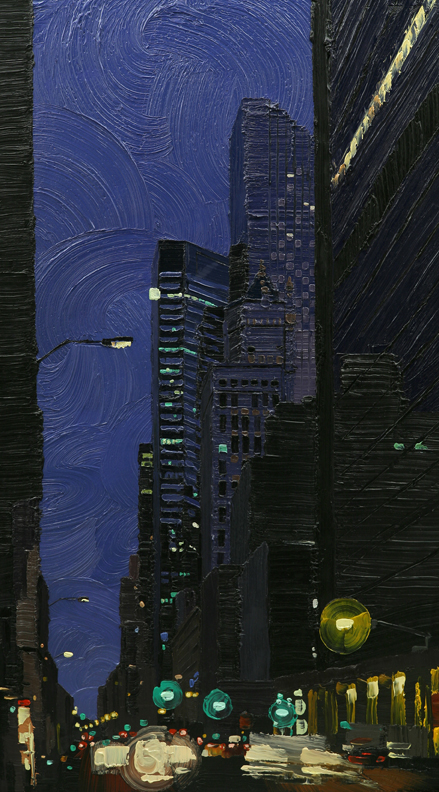
 Leo Bugel - City Nights I, III  -  Oil on board  -  48 X 24 each


Karen Hollingsworth  -  Contemplation  -  Oil on canvas  -  40 X 40


Bryan Mark Taylor  -  Twilight On Sutter Street (L)  -  Oil on canvas  -  12 X 9
View From Coit Tower (R)  -  Oil on canvas  -  12 X 9


James Crandall  -  Towers Over Union Square  -  Oil on canvas  -  18 X 24


Wayne Jiang - Fences and Open Field  -  Oil on canvas  -  Acrylic on canvas  -  12 X 40


Friday, January 18, 2013

Face Yourself - January 2013


Victoria Dalkey: Artists face themselves at Elliott Fouts

Published: Friday, Jan. 18, 2013 - 12:00 am | Page 26TICKET
"Face Yourself" at the Elliott Fouts Gallery is a show of self-portraits by artists who are not, for the most part, known for their figurative work. The result is a show that ranges from a straightforward, traditional self- portrait by Bryan Mark Taylor to a psychologically fraught painting by John Tarahteeff, who depicts himself as a sailor in a beached boat with a broken mast.
Both are finely done and offer insights into the characters of the artists. Taylor's tender color and tactile paint handling give us a glimpse into the soul of an artist who is a sensitive colorist. Tarahteeff's symbolic painting suggests that he is a melancholy and self-dramatizing storyteller.
  Between these two extremes are some marvelous and surprising works. Jennifer Balkan gives us a piquant and painterly self-portrait as an angel with a crown of roses. This image, which is reminiscent of a Norman Rockwell (whose works are up at the Crocker), jumps off the wall with joie de vivre.
  Ryoko Tajiri abstracts her image with angular planes that in some senses efface her visage, but nevertheless offer a subtle and intriguing painting. John Karl Claes gives us a moody gestural image in sombre yet rich tones and Kenny Mencher challenges us with a dashing self-portrait in a Lone Ranger mask.
  Some of the artists present only portions of their faces or figures. Randy Brennan's "I'm Complicated" takes the form of a floral painting of vines and a vase that has sliding panels that open to reveal a mouth and an eye. James Crandall focuses on his hands intertwined and moving apart in a beautifully drawn image. Jelaine Faunce reduces herself to an Angelina Jolie-like pair of plump lips.
  Others let images or objects stand in for themselves. Maren Conrad fancies herself a sexy mermaid who ought to hang in the Dive Bar. Terry Pappas depicts herself as a Buddhist goddess with a bird. Teresa N. Fischer also holds a bird, a wind-up toy, to her ear, listening intently to its silent song.
  The most compelling work in the show is Gale Hart's image of a girl with an ax confronting a panel with a relief line drawing of the same figure. Both girls have one foot that belongs to a pony rather than a human, and the overall feeling is one of menace and anger. Hart, whose works often address animal rights, offers an emotive and ambiguous statement of human culpability here.
All in all it's an enjoyable and thought-provoking exhibit, as is "The Collector: John Turner and the Art of Acquisition" across the street from Fouts at the Center for Contemporary Art, Sacramento. This delightful exhibition showcases objects from one man's collection of ethnographic, folk and outsider art.
  Turner, an inveterate traveler who moved with his family to Vietnam and Taiwan when he was a teenager, began his career as a film editor in New York City before moving to the Bay Area in the 1970s, where he worked as a television news editor, arts producer, writer and curator. Over the past 35 years, he has visited more than 70 countries, finding odd objects such as a coconut carved into an image of Fidel Castro.
  A haunter of thrift stores, he has acquired a marvelous selection of paintings, including a visionary image of Moses with the burning bush, an image of Elvis combing his hair in a mirror and a dark painting of two sullen young girls who seem to float on air. A medical sign from Mali depicts a dictionary of ailments from bad eyesight to flatulence.
A high point of the exhibit are several works by the renowned outsider artist the Rev. Howard Finster, including a childlike rendition of Turner emerging from the Amazon River and a wonderful, etched sheet metal wall sculpture titled "Queen Heneretta Wife of Charles I." These are mind-boggling, strange and enchanting works.
  Note: If you are a fan of traditional watercolor painting, you should check out the American Watercolor Society's traveling exhibition from New York. It's up at the Sacramento Fine Arts Center, 5330 Gibbons Drive, Carmichael, through Jan. 26. For information, call (916) 971-3723.

FACE YOURSELF

Where: Elliott Fouts Gallery, 1831 P St., Sacramento
When: 11 a.m. to 6 p.m. Tuesday-Friday; 11 a.m. to 4 p.m. Saturday-Sunday through Jan. 31
Cost: Free
Information: (916) 736-1429; www.efgallery.com